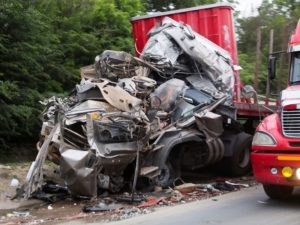


A distracted commercial driver is subject to federal rules stricter than those that apply to ordinary motorists, and that difference is the leverage in these lawsuits. A Michigan distracted truck driver accident lawyer pursues the driver’s phone records, the truck’s electronic data, and the carrier’s own policies. Christensen Law handles these claims statewide from offices in Southfield, Detroit, Grand Rapids, Ann Arbor, and Troy.
Trucking companies begin investigating within hours of a crash. Call our distracted commercial driver cash attorney in Michigan at (248) 900-9000 so that someone is doing the same for you.
CHRISTENSEN LAW HAS A 24 HOUR RAPID RESPONSE SERVICE
What Federal Rules Apply to a Distracted Truck Driver?
Federal regulations ban texting and hand-held phone use by commercial drivers outright, with no allowance for a quick glance. The Federal Motor Carrier Safety Administration enforces two separate provisions that reach both the driver and the company.
Under 49 CFR 392.80, no driver may engage in texting while driving a commercial motor vehicle, and no motor carrier may allow or require it. Under 49 CFR 392.82, no driver may use a hand-held mobile telephone, and again, the carrier is barred from allowing or requiring it.
The definitions matter as much as the prohibitions. Hand-held use includes holding a phone to make a call, dialing by pressing more than a single button, or reaching for a device in a way that requires moving out of a seated, belted position. Driving includes time temporarily stationary in traffic or at a light with the engine running.
The penalties signal how seriously these rules are treated. FMCSA lists civil penalties reaching $2,750 for drivers and $11,000 for carriers that allow or require violations, with repeat convictions bringing 60-day and 120-day commercial license disqualifications. Michigan’s own hands-free law, MCL 257.602b, applies on top of the federal rules.
Why the Carrier Is Often the More Important Defendant
The company behind the truck usually has both deeper responsibility and deeper coverage than the driver. This is the single biggest structural difference between a truck case and a car case.
Two distinct theories reach the carrier. The first is vicarious liability, where the company answers for a driver acting within the scope of employment. The second is direct negligence by the company itself, which is where the more serious evidence usually lives.
Direct claims we investigate against carriers:
- Contacting drivers by phone or messaging system while they were on the road
- Dispatch schedules that made compliant communication practically impossible
- No written distracted driving policy, or a policy never enforced
- Hiring or retaining a driver with a known record of device violations
- Failing to train on the federal device rules
- Incentive structures that rewarded speed over compliance
Note that 49 CFR 392.82(a)(2) prohibits a carrier from allowing or requiring hand-held use, which makes company phone policies, dispatch logs, and fleet messaging records directly relevant rather than merely interesting.
What Evidence Proves a Truck Driver Was Distracted?
Commercial vehicles generate far more data than passenger cars, which is an advantage only if the data is preserved. Most of it sits in the carrier’s control from the moment of the crash.
Electronic logging and engine data
Electronic logging devices record duty status and driving time, and engine control modules capture speed, throttle, and braking. An absence of braking before a rear-end impact is powerful evidence that the driver never saw the traffic ahead.
Telematics, cameras, and messaging
Many fleets run forward-facing and driver-facing cameras, GPS tracking, and in-cab messaging platforms. Those systems can show what the driver was doing and what the company was sending, and they overwrite on a schedule.
Phone and carrier records
Records from the driver’s personal phone and any company-issued device establish call and message activity to the second. These come out through subpoena, which requires a claim to be formally underway.
Personnel and compliance files
The driver qualification file, training records, prior violations, and the company’s safety policies address the direct negligence claims rather than the crash itself.
All of it depends on early preservation. We send spoliation letters immediately and, where necessary, seek court orders to secure the truck and its data before repairs or routine data cycling removes them.
Why Injured Michiganders Choose Christensen Law for Truck Cases
Truck cases are litigation from day one, because carriers and their insurers treat them that way. We are built for that posture.
- A Michigan trial firm applying both Michigan no-fault law and the federal motor carrier regulations
- Five offices, in Southfield, Detroit, Grand Rapids, Ann Arbor, and Troy, with cases handled statewide
- We move on preservation demands and inspection before the truck returns to service
- Our focus is serious and catastrophic injury, including traumatic brain and spinal cord cases
- We work with reconstruction engineers and data download specialists rather than relying on the carrier’s account
- You will know the attorney handling your case and be able to reach that person
The other side has a team on the ground within hours. If a commercial vehicle injured you or someone in your family, call (248) 900-9000 today.
How Does Fatigue Overlap With Distraction?
Distraction and fatigue frequently appear in the same file, and the same records prove both. A driver reaching for a phone late in a long shift is a different case from one doing it in hour two.
Federal hours-of-service rules limit driving time and require rest, and electronic logging devices record compliance. Those logs sit alongside the phone records in discovery, and together they often explain why a driver failed to react.
What the combination tends to reveal:
- Log entries showing driving beyond permitted hours, or edited to appear compliant
- Device activity during periods logged as off-duty rest
- Dispatch schedules that could not be met within lawful driving hours
- Engine data showing no braking, consistent with inattention rather than a late reaction
- Messaging traffic from the carrier during driving periods
A carrier that built a schedule requiring violations has a problem beyond its driver’s conduct. That is a direct negligence claim, and it is usually worth more than the driver’s individual lapse.
Why Truck Crash Injuries Are More Severe
A loaded tractor-trailer can weigh many times what a passenger vehicle weighs, and physics does the rest. The same distraction that causes a fender bender between two cars causes a catastrophic event when the striking vehicle is a semi.
Stopping distance compounds the problem. A fully loaded truck needs substantially more room to stop than a car at the same speed, so a driver who looks up two seconds late has already run out of road.
The injuries in a Michigan semi-truck distracted driving claim reflect that difference, and they commonly include traumatic brain injury, spinal cord damage, multiple fractures, internal organ injury, and amputation. Underride collisions, where a smaller vehicle travels beneath a trailer, produce especially severe outcomes.
Injuries at this level clear Michigan’s statutory threshold readily, so these cases turn on causation and valuation rather than on whether a claim exists at all. Our Michigan truck accident practice covers how those cases get built.
Michigan’s freight corridors concentrate the risk. I-94, I-75, I-96, and US-131 carry heavy interstate volume through areas where commuter traffic merges and slows, and a distracted driver in a loaded truck has almost no margin in that environment.
What Can You Recover, and How Long Do You Have?
Your own no-fault benefits come first and are not affected by the truck driver’s conduct. Personal Injury Protection pays medical care, a portion of wage loss for up to three years, replacement services, and mileage regardless of fault.
The claim against the driver and the carrier reaches everything beyond that. MCL 500.3135 permits noneconomic damages where there was death, permanent serious disfigurement, or a serious impairment of body function, and the same section supports recovery of excess economic loss above your PIP limit.
Commercial policies are the reason these claims resolve at higher figures than car cases. Federal minimum financial responsibility levels for interstate carriers start well above Michigan’s minimum liability limits, and large fleets carry considerably more.
Deadlines still bite. Three years to sue under MCL 600.5805, one year for no-fault notice under MCL 500.3145, and comparative fault under MCL 600.2959, reducing damages by your share of responsibility.
The attorneys and staff there are amazing and really care about their clients where you're treated with care and not... Jason Waddell From the 1st interaction with Christensen Law it was a positive, wonderful experience! Dustin, Samantha and the entire staff, had... Susan Schroeder They took amazing care of my uncle after his accident. I would recommend then to anyone injured in an auto... Steve Huber They were well-versed in the intricacies of the law and provided me with clear explanations of my rights and legal... Shana Goodrich I presented to them a situation that was quite scary and financially overwhelming. David and his kind staff listened to... Wendy Henn Thanks to Dave, Stephanie, and Michelle for getting me through this hard time. I didn't know what to do, I... Tim Taylor Christianson Law stepped in after my motorcycle accident when another firm had dropped the ball—and they completely and very quickly... Erin Magee They were communicative, compassionate, made the process easy for me to understand. I was able to effectively receive a size-able... Wren Bell He, Samantha, and the entire staff at Christensen Law treated me like family, demonstrating kindness, expertise, and a genuine interest... Janelle Garza The Christensen Law firm, compassionate approach to my injuries. Their attentive listening, and thorough understanding are truly commendable I highly... Mr. Douglas Whole team of Christensen law is amazing and wonderful from start to finish. They often contact me to see how... Amandeep Sohal From start to finish, the entire team was professional, compassionate, and dedicated to achieving the best possible outcome for me.... Gjon Ivezaj I recommend all of my friends and family to Christensen Law.
 Excellent!
 Christensen Law’s attorneys are filled with compassion and knowledge
The team at Christensen Law impressed me with their vast knowledge and experience in handling...
 It is with extreme gratitude and positive emotions that I write about my relationship with...
If it wasn't for Christensen Law, I don't know where I would be today.
 My name is Erin, my experience with Christensen Law was Overwhelming… But in the very...
I hired this law firm after being hit by a drunk driver in my of...
 From the moment I spoke with Dustin, I felt like I was in good hands
I am extremely pleased with the experience I had with this law firm, and their...
 I was in difficult time in my life, it’s a great to know I have...
I had an excellent experience working with Christensen Law on my settlement case.

What Happens in the First Weeks of a Truck Case?
The opening phase is about securing evidence that the other side controls. Almost everything decisive in a distracted commercial driver crash sits in the carrier’s possession on the day of the crash.
Preservation and inspection
We send spoliation letters identifying the specific data, footage, and documents to be retained, and we arrange to inspect and download the truck before it returns to service. Where a carrier resists, a court order is the next step.
Investigation and reconstruction
Reconstruction engineers work from the scene, the vehicles, and the engine data. Federal and state inspection records for the truck and the driver come in alongside that analysis.
Protecting the client from early contact
Carrier representatives and adjusters often reach injured people within a day or two. We take over that contact so nobody is giving a recorded statement while still in a hospital bed.
Doing this properly takes weeks rather than days, and it is the reason these cases resolve differently from ordinary crash claims.
Common Questions Answered by Our Michigan Distracted Truck Driver Accident Lawyers
These are the questions we hear most from Michigan families after a crash involving a commercial vehicle.
Through records rather than inference. Phone and carrier data, in-cab messaging logs, camera footage, and engine data together establish device use, and the federal rules make that use a violation rather than a judgment call.
Usually both. The carrier answers for a driver acting within the scope of employment and can also be directly liable for its own hiring, training, policy, and dispatch practices.
The analysis gets more involved but rarely dead-ends. Leasing arrangements, placarding, and the degree of control a motor carrier exercises often bring the company in, despite an independent contractor label.
Not before getting advice. A carrier’s adjuster or a rapid response team may contact you within a day, and early recorded statements are used to limit claims rather than to help you.
That is common, and it does not prevent a Michigan claim. A crash on Michigan roads generally supports suit here, and interstate carriers are subject to the federal regulations regardless of where they are based.
Longer than car cases, generally, because the discovery is heavier and the defense is better funded. That is also why they should not be settled early, before the medical and economic picture is complete.
Talk With a Michigan Distracted Truck Driver Accident Lawyer
Electronic logs, camera footage, and messaging records all cycle out on schedules measured in days and weeks. The single most useful thing you can do is make sure someone demands their preservation now.
Call Christensen Law at (248) 900-9000 or reach us through our contact page. We handle commercial vehicle cases throughout Michigan, including through our Detroit truck accident practice.