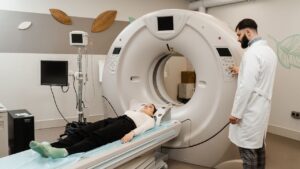


This Michigan Brain Injury Guide explains how brain injury and catastrophic injury claims actually work in Michigan, from the first hospital records through the two separate insurance claims the state’s no-fault system creates. It is written for injured people and for the families who end up managing everything while someone recovers.
Michigan handles these injuries differently from almost every other state. Two claims run at once under different rules; medical benefits are capped at a level someone selected years ago, and the deadlines that matter most are shorter than people assume. Understanding that structure early changes outcomes.
What Counts as a Catastrophic Injury in Michigan?
A catastrophic injury is one that permanently changes what a person can do, rather than one that heals on a schedule. Michigan law does not use the term as a formal category for auto claims, so it functions as a practical description of injuries requiring lifetime care or causing permanent loss of function.
The injuries that fall into this group share one feature: the costs continue long after treatment stops being about recovery and starts being about maintenance.
- Traumatic brain injury, from persistent concussion symptoms through severe injury requiring lifelong supervision
- Spinal cord injury, including partial and complete paralysis
- Amputation, whether traumatic at the scene or surgical afterward
- Severe burns and electrocution injuries
- Multiple orthopedic trauma requiring repeated surgical reconstruction
- Internal organ damage with permanent functional loss
- What connects these for claim purposes is that the future loss exceeds everything already spent. That shifts the entire analysis from tallying receipts to projecting decades.
Why the Brain Injury Cases Are the Hardest to Prove
Brain injuries are frequently the most disabling and the least visible. A person with a spinal cord injury has imaging that shows the damage, while a person with diffuse axonal injury may have entirely normal scans.
The National Institute of Neurological Disorders and Stroke classifies TBI severity primarily on the Glasgow Coma Scale combined with loss of consciousness and imaging, and notes that symptoms lasting weeks or longer are described as post-concussion syndrome.
The Centers for Disease Control and Prevention reports that its hospitalization and death figures exclude the many TBIs treated only in an emergency department, urgent care, or not at all.
That gap between what is happening and what is documented is the central problem in these claims. It is also solvable, with the right medical follow-through.
Discover the critical medical tests and modern treatment methods that can change the course of a traumatic brain injury recovery.
How Does Michigan’s No-Fault System Handle a Catastrophic Injury?
Michigan splits every serious auto injury into two separate claims that run at the same time under different rules. Confusing them is the most common and most expensive misunderstanding we see.
The first-party claim goes to your own auto insurer for Personal Injury Protection benefits. Fault is irrelevant to it. The third-party claim goes against whoever caused the crash, and fault is the entire question.
| Feature | First-party (PIP) claim | Third-party claim |
|---|---|---|
| Who pays | Your own auto insurer | The at-fault party’s liability insurer |
| Does fault matter | No | Yes, and it reduces recovery |
| Medical bills | Yes, up to your coverage level | Only amounts above that level |
| Wage loss | Up to 85%, for three years maximum | Everything past three years |
| Pain and suffering | No | Yes, if the injury clears the threshold |
| Attendant care | Yes, when prescribed | Future care above the PIP limit |
| Deadline | One year to give written notice | Three years to file suit |
Reading across that table explains why catastrophic cases need both claims built properly. Neither one alone covers a lifetime injury.
What PIP Benefits Actually Cover
Under MCL 500.3107, allowable expenses include reasonable charges for reasonably necessary products, services, and accommodations for an injured person’s care, recovery, or rehabilitation. In a catastrophic case that language reaches further than most people expect.
- Hospital, surgical, and rehabilitation care
- Attendant care, including care provided at home by family members when a physician prescribes it
- Case management, cognitive rehabilitation, and neuropsychological treatment
- Up to 85 percent of lost wages for as long as three years
- Replacement services for household tasks the injured person can no longer perform
- Home and vehicle modifications, and transportation to treatment
- Survivor’s loss benefits for dependents after a fatal injury
Attendant care is usually the largest and most contested item in a severe brain injury file. It is also the one families most often provide for months without realizing it is compensable.
How Much Medical Coverage Do You Actually Have?
Your PIP medical limit is whatever level was selected on the policy you claim under, and since the 2019 no-fault reform, that is no longer automatically unlimited. This single fact determines the shape of a catastrophic claim.
Drivers now choose among unlimited coverage, $500,000, and $250,000, with a $50,000 option restricted to people enrolled in Medicaid and a full opt-out available to households with qualifying Medicare coverage. A policy with no selection recorded defaults to unlimited benefits, which is always worth verifying before accepting that coverage has run out. The state’s own guide to choosing PIP medical coverage sets out the tiers.
A severe brain or spinal injury can exhaust a $250,000 limit during the first hospitalization. Everything past that becomes an excess economic loss claim against the at-fault party, which is why the third-party case carries so much weight in catastrophic cases.
Which Policy Applies to You
Coverage level and coverage source are separate questions. MCL 500.3114 sets the order of priority, generally running from your own policy, to a spouse’s policy, to that of a relative living in your household.
Where no household policy applies, a claim may run through the Michigan Assigned Claims Plan under MCL 500.3172. Motorcyclists follow a different sequence entirely, because motorcycles are not motor vehicles under the act, and riders reach PIP benefits only where a motor vehicle was involved.
Getting priority wrong costs months. Filing against the wrong insurer while the one-year notice clock runs is a genuinely serious error.
When Can You Sue the At-Fault Party?
You can pursue pain and suffering only if the injury clears Michigan’s statutory threshold, which catastrophic injuries almost always do. MCL 500.3135 permits noneconomic damages where there was death, permanent serious disfigurement, or a serious impairment of body function.
Serious impairment means an objectively manifested impairment of an important body function that affects the person’s general ability to lead a normal life. The operative word is objectively, meaning the impairment must be observable or perceivable from actual symptoms or conditions rather than reported alone.
Shared fault still reduces recovery. Under MCL 600.2959, damages drop in proportion to the injured person’s share of responsibility, and a person found more than 50 percent at fault cannot recover noneconomic damages at all.
If you are working through a catastrophic injury and are not sure which claims apply to your situation, our attorneys can walk through it with you at (248) 900-9000.
What Deadlines Apply, and Which One Bites First?
Two written deadlines govern, and the shorter one is the one people miss. A third, unwritten deadline governs the evidence and is shorter than both.
- One year from the injury to give your no-fault insurer written notice, under MCL 500.3145. The notice must identify the injured person and the time, place, and nature of the injury.
- One year back from the date suit is filed, as the limit on how far back recoverable benefits reach. A claimant can be timely on notice and still lose older bills.
- Three years from the injury to file suit against the at-fault party, under MCL 600.5805.
- Far shorter notice periods where a government vehicle or a road authority may be responsible, sometimes measured in months.
Michigan law provides limited tolling in some circumstances involving minors or a person who lacks legal capacity, which arises genuinely often in severe brain injury cases and needs individual review rather than assumption. There is relief inside the one-year-back rule too, since that period is tolled from the date a specific claim for payment is made until the insurer formally denies it.
Why Evidence Deadlines Matter More Than Statutes
Nothing in any statute preserves the proof. Vehicles are moved to salvage within weeks, business camera footage overwrites on loops measured in days, and skid marks disappear with the next weather system.
In commercial vehicle cases, the data sits with the carrier, including electronic logging records, engine data, and in-cab messaging. Formal preservation demands are the only reliable way to keep it.
What Happens During a Catastrophic Injury Claim?
These cases move through recognizable stages, and the timeline is longer than most people expect, usually measured in years rather than months. Understanding the sequence removes a lot of the anxiety that comes from feeling like nothing is happening.
- Emergency and acute care. The records created here become foundational evidence, including imaging, operative reports, and consultation notes.
- PIP application and benefit setup. The application for benefits goes in, priority is established, and the insurer begins paying medical and wage loss.
- Investigation and preservation. Vehicles are inspected, data downloaded, scene evidence documented, and witnesses interviewed.
- Rehabilitation and medical stabilization. Often six months to two years, and the point at which permanent deficits become assessable.
- Damages development. Life care planning, vocational assessment, and economic analysis project lifetime costs and lost earning capacity.
- Negotiation or filing. A demand goes out once the picture is complete, or suit is filed if deadlines require it sooner.
- Litigation and resolution. Discovery, depositions, medical examinations, mediation, and trial if needed.
The single most consequential decision in that sequence is refusing to value the case before medical stabilization. A catastrophic injury claim settled at six months cannot account for what is still unfolding at 24 months.
How Insurers Commonly Behave in These Cases
None of the following is improper, and all of it is predictable enough to prepare for. Knowing the pattern is most of the defense against it.
- Scheduling an insurance medical examination and using the resulting report to suspend benefits
- Cutting off attendant care hours or reducing the hourly rate paid to family caregivers
- Commissioning a records review by a physician who never examined the injured person
- Attributing deficits to a pre-existing condition, depression, or medication
- Using surveillance and social media to argue normal functioning
- Offering early settlement while the medical picture is still uncertain
The counter to all of it is contemporaneous documentation. Dated caregiver logs, consistent treatment, and treating physicians who record specific functional restrictions carry these disputes far better than argument does.
What Families Consistently Misunderstand
Three misconceptions cause the most damage in our experience. Each one is easy to correct early and hard to fix later.
The first is believing that a normal CT scan rules out a brain injury. It does not, because emergency imaging is designed to find bleeding that needs surgery, not diffuse injury.
The second is assuming that unpaid family caregiving is simply what families do. Attendant care provided at home is compensable when prescribed, and undocumented months of it are rarely recovered retroactively.
The third is treating improvement as recovery. Gains are typically fastest in the first six months and slow considerably afterward, and a plateau is not the same as a return to baseline.
How Do Lawyers Evaluate a Catastrophic Injury Case?
Evaluation rests on three records that develop at different speeds, and a case is only ready to value when all three are complete. That is why honest answers about case worth are slow to arrive.
The liability record establishes who was responsible and to what degree, built from reconstruction, vehicle data, scene evidence, and witness accounts. The medical record establishes the injury objectively, through imaging, surgical findings, neuropsychological testing, and documented restrictions. The damages record projects the future, through life care planning, vocational assessment, and economic analysis.
Coverage sits alongside all three. A catastrophic claim against a minimally insured driver is a different case from the same claim against a commercial carrier, and identifying every available layer, including underinsured motorist coverage on your own policy, often determines what a family actually recovers.

Michigan Traumatic Brain Injury Legal Guide FAQs
Usually two to four years, and sometimes longer. The timeline is driven by medical stabilization rather than by legal process, because permanent deficits cannot be assessed until recovery plateaus. Cases that settle quickly generally do so at the cost of not accounting for lifetime needs.
Yes, when the care is reasonably necessary and prescribed by a physician. Michigan no-fault covers attendant care provided by family members, though insurers routinely dispute both the number of hours and the hourly rate. Contemporaneous daily logs are the strongest support for these claims.
A guardian or conservator may need to be appointed through the probate court to make medical, financial, and legal decisions. This is common in severe brain injury cases and runs parallel to the injury claim rather than delaying it.
No. Standard imaging can be normal in mild and diffuse brain injuries, which are the most frequently missed. Neuropsychological testing measures function rather than structure and often identifies deficits that imaging does not show.
Remaining medical costs become part of the excess economic loss claim against the at-fault party. Health insurance, Medicaid, or Medicare may also come into play, and coordination between those sources needs careful handling to avoid reimbursement problems later.
Report the crash to your own insurer as your policy requires. Beyond that, recorded statements and broad medical authorizations are worth reviewing with a Michigan brain injury lawyer first, particularly while you are still in treatment.
No statutory cap applies to noneconomic damages in an auto case that clears the threshold. That also means there is no formula, so specific evidence about what a person could do before and cannot do now carries more weight than general descriptions of suffering.
Talk With a Michigan Brain Injury and Catastrophic Injury Attorney
Catastrophic injury claims are decided by the quality of the record, and that record is being created right now in appointments, discharge summaries, and caregiver notes. Getting the structure right early is far easier than reconstructing it two years on.
Christensen Law is a Michigan trial firm with offices in Southfield, Detroit, Grand Rapids, Ann Arbor, and Troy, and we take these cases across the state.
Call (248) 900-9000 or reach us through our contact page.